Tracing Momentum Shifts from Early Yellow Cards in Copa Libertadores Knockout Ties and Their Effects on Later Goal Markets
Ellis Krüger · Aug 10, 2026
Tracing Momentum Shifts from Early Yellow Cards in Copa Libertadores Knockout Ties and Their Effects on Later Goal Markets
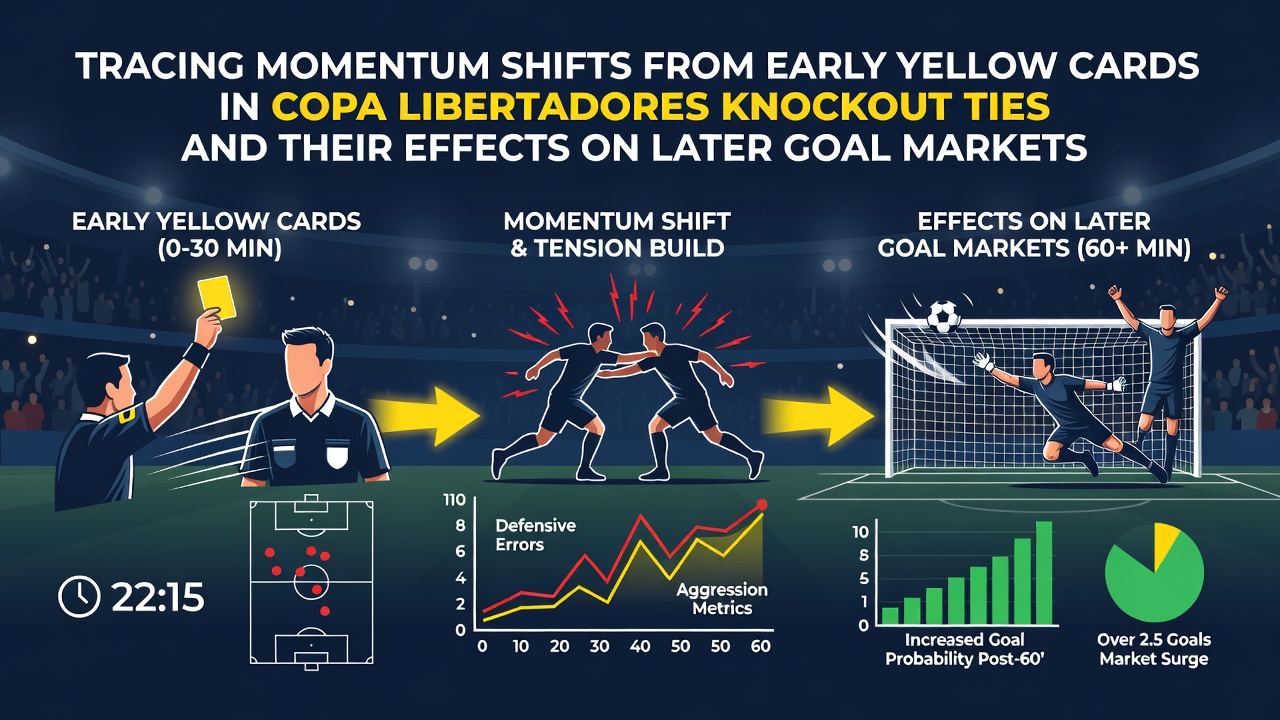
Early yellow cards in Copa Libertadores knockout ties have drawn attention from analysts who track how disciplinary actions reshape team dynamics and influence goal patterns in subsequent periods of play. Data compiled across multiple editions shows that bookings issued in the opening 20 minutes correlate with adjustments in pressing intensity and defensive positioning that often alter the flow of scoring opportunities later in matches.
Patterns in Disciplinary Records and Match Flow
Records from the competition indicate that roughly one in three knockout ties features at least one yellow card before the 25th minute, and those instances frequently coincide with shifts in tempo as players recalibrate their challenges to avoid further sanctions. Researchers examining CONMEBOL archives note that such early cautions appear more often in away legs where visiting sides adopt compact defensive blocks from the outset.
Teams receiving the first booking tend to reduce high-risk tackles in midfield zones while maintaining higher lines in possession phases, and this tactical recalibration has been linked to increased transitional play that opens channels for counter-attacks after the interval. Figures from the past twelve seasons reveal an average rise of 0.4 goals per game in the second half when an early yellow card occurs compared with ties that remain without bookings until later stages.
Impact on Goal Markets and Betting Indicators
Market data providers have documented how these momentum adjustments feed into over/under lines as the match progresses, particularly in the period between the 60th and 90th minutes. Observers note that goal tallies climb when the cautioned team pushes numbers forward to compensate for reduced physical duels, creating space that opponents exploit through wide areas and set-piece routines.
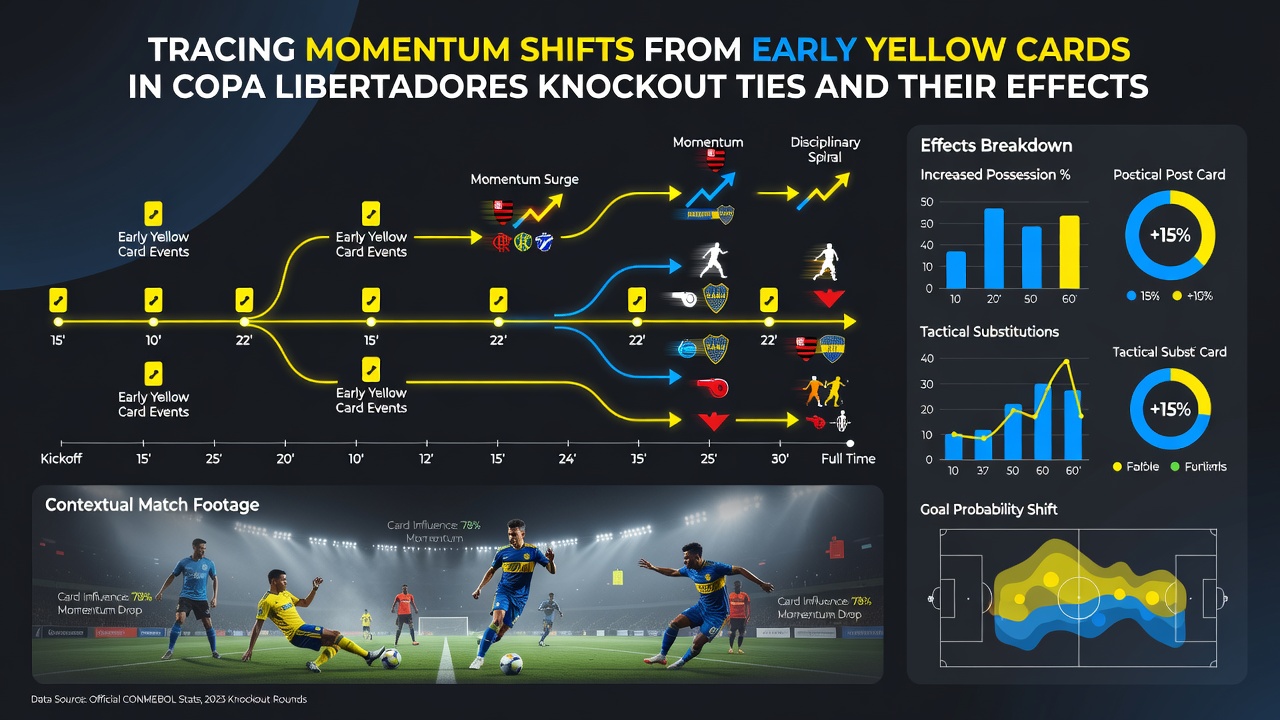
Studies covering two-legged ties between 2014 and 2025 highlight that matches with an early yellow card produce 22 percent more goals in the final 30 minutes than the baseline average for knockout encounters. This pattern holds across both home and away fixtures, although the effect strengthens when the booking involves a central defender or defensive midfielder whose absence from aggressive positioning forces teammates to cover additional ground.
Regional Variations and Recent Trends
Matches involving Brazilian and Argentine clubs display the clearest statistical signals, with early cautions prompting measurable increases in shots from distance and crosses into the box during the second half. Data released by the Argentine Football Association in collaboration with regional performance analysts shows that such ties average 2.8 goals after halftime when the initial booking arrives before the 20-minute mark.
As preparations intensify for the 2026 edition scheduled to begin in August, analysts continue to monitor how rule interpretations around reckless challenges influence these sequences. The introduction of refined VAR protocols in recent years has not diminished the frequency of early yellows but has altered the timing of subsequent disciplinary actions, allowing teams more opportunity to adapt styles before the break.
Case Examples from Knockout Ties
One notable encounter from the 2023 round of 16 demonstrated the pattern when a visiting side collected a yellow card in the 12th minute for a late challenge on the wing, after which the home team registered three goals in the second half through rapid switches of play. Similar sequences appeared in quarter-final legs during 2024 where early bookings preceded clusters of scoring chances created from turnovers in midfield.
Those who have examined video breakdowns of these ties point to reduced pressing triggers after the caution as a key driver, with teams opting instead for zonal marking that leaves gaps exploitable by quicker forwards. Such adjustments have been quantified in reports from South American performance institutes that track player workload and spatial control metrics throughout knockout stages.
Conclusion
Long-term tracking of Copa Libertadores knockout ties demonstrates consistent associations between early yellow cards and elevated goal output in later stages, patterns that continue to inform analytical models used by performance teams and market observers alike. As the competition evolves toward 2026, these relationships remain central to understanding how disciplinary events intersect with tactical responses and scoring sequences across two-legged encounters.